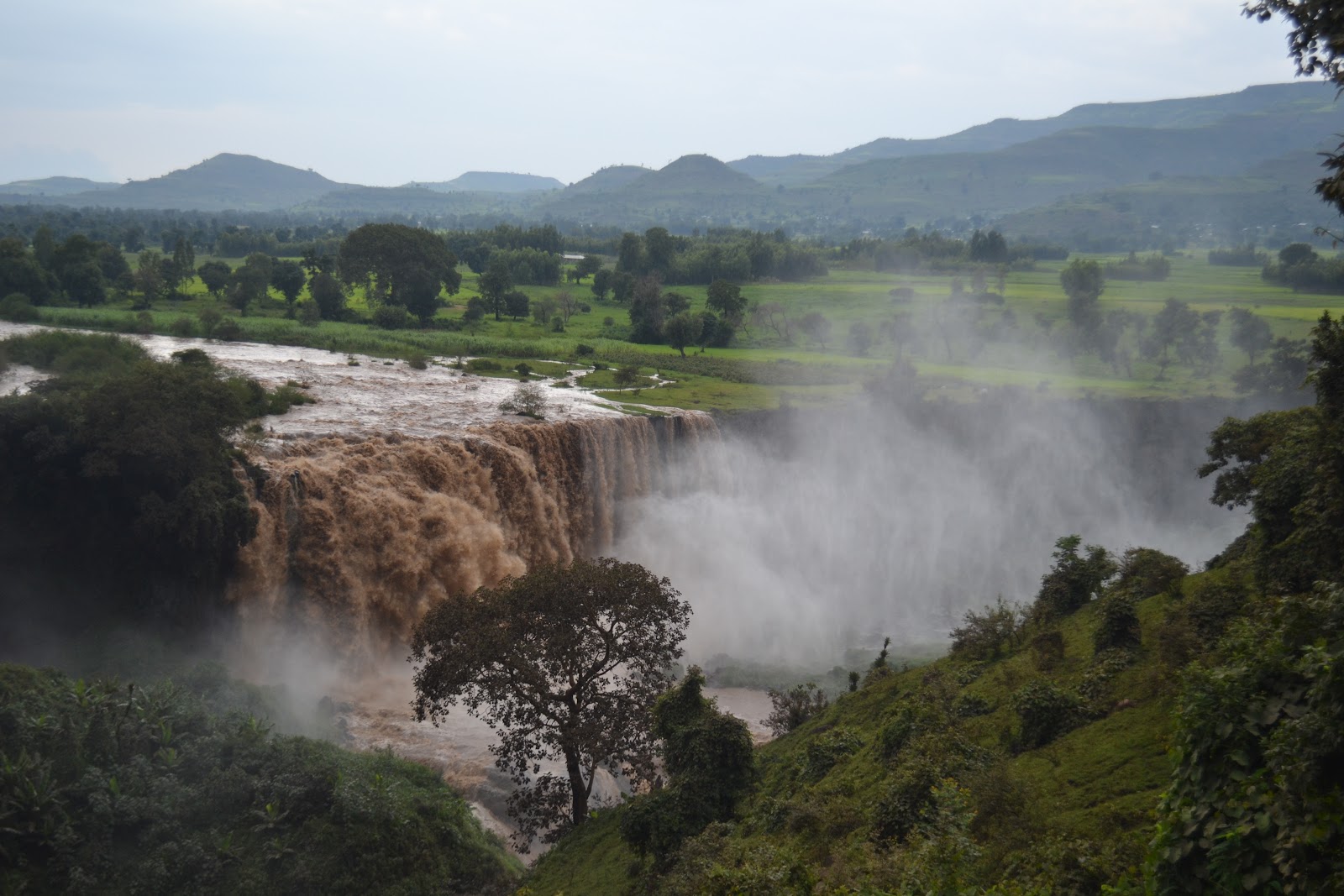
It is difficult to have to distill all of these landscapes and experiences into a few pictures and paragraphs!
Ethiopia is grossly underrated as a tourist destination. There are no real issues of safety and security (until we get to the Danakil, a post or two in the future), the people are friendly, the scenery is breathtaking, and the history is unexpectedly rich. If anyone is interested, I do have some contacts and suggestions so please do not hesitate to let me know.
 |
| On the road to the Semien Mountains - more volcanic plugs! |
 |
| The view on the high plateaus |
For the city of Aksum, I will quote directly from my parents' blog :
 "Axum is the holiest city and the most ancient capital of Ethiopia! And yet, very little research or excavation has been done up until now. From around 400 B.C. to the 10th century, Axum was a major trade center. Under the influence of two Syrian missionaries, King Ezana embraced christianity in 340 AD and that was the start of the Ethiopian Orthodox church. According to the Orthodox religion, the original Ark of the Covenant was taken from Israel to where it has been kept ever since in the Holy of Holies in a chapel in the center of Axum. Another attraction here are the stellae fields, the northern one being the most famous. Stelae are believed to be funeral monuments to kings and markers of underground tombs and treasury chambers that form an intricate well-preserved network of catacombs often going back as far as 1700 years. Excavations are underway but the areas are huge. Finally, tourists usually visit the ruins of Queen of Sheba’s palace and her swimming pool but keep in mind that it is difficult to differentiate between fact and legend concerning the Queen of Sheba. For more information, check the wiki link at http://en.wikipedia.org/wiki/Queen_of_Sheba and judge for yourself."
 |
| An ancient manuscript inside the largest church |
 |
| Coffee ceremony (the roasting of the beans part) outside of the Aksum archeological museum |
The Semien mountains were formed between 40 and 25 million years ago and are essentially the remains of a massive volcano. The highest peak, Ras Dejen, towers at 4,543 meters (14,905 ft) and is the 4th highest mountain in Africa. The biodiversity is very strong here and many species of both plants and animals are endemic and not found anywhere else. Of particular interest is the Ibex and the Ethiopian Wolf, although we did not have any luck spotting any - they are extremely endangered.
For most of our small trek we were above 3,000 meters and the altitude can felt a bit - shortness of breath, but also the very cool air and fog. Seeing te Bleeding Heart baboons through the mist, just a few meters away, was a real treat!
Our little trek :
View Larger Map
 |
| Bleeding heart baboons in the wild |

 |
| Local kids singing songs and selling wares. |


 |
| Wild mountain goats doing their thing |